https://doi.org/10.33595/2226-1478.10.2.386
Contribution of storytelling for the creation of emotional marketing in a company of purified water of bahía de Caráquez, Ecuador 2019
Aporte del storytelling para la creación del marketing emocional en empresa de agua purificada de bahía de Caráquez, Ecuador 2019
César Arturo Carbache Moraa, Sara Margarita Ureta Uretab, Joel Antonio Nevarez Verac
ULEAM, Bahía de Caráquez extensión
b saraureta95sara @ gmail .com
César Arturo Carbache Mora https://orcid.org/0000-0001-9373-2873
Sara Margarita Ureta Ureta https://orcid.org/0000-0002-9881-535X
Joel Antonio Nevarez Vera https://orcid.org/0000-0002-0810-1581
ABSTRACT:
Currently, brands have realized that creating an emotional bond in their target groups opening advantages over competition and have found in the old art of storytelling the perfect ally for that purpose. Storytelling is a powerful strategy that allows you to create that emotional link between producer and consumer. The objective of this research is to analyze the contribution of storytelling to generate emotional marketing strategies in purified water companies in the city of Bahía de Caráquez. The methodology implemented was the observation and application of surveys to customers of said product. The results were that consumers by brand preference are at 26.7 percent. However, 21.7 percent have little knowledge of the advertising of the companies under study. It is proposed that companies engaged in this commercial activity lack emotional marketing strategies based on the creation of stories that expand their field of service, attraction and customer loyalty.
Keywords:Storytelling, Emotional Marketing, Brand.
RESUMEN:
Actualmente las marcas se han percatado que creando un vínculo emocional en sus grupos meta apertura ventajas por sobre la competencia, y han encontrado en el viejo arte de contar historias el aliado perfecto para ese propósito. El storytelling es una potente estrategia que permite crear ese vínculo emocional entre productor y consumidor. El objetivo de esta investigación es analizar el aporte del storytelling para generar estrategias de marketing emocional en empresas de agua purificada de la ciudad de Bahía de Caráquez. La metodología implementada fue la observación y aplicación de encuestas, a clientelas de dicho producto. Los resultados fueron que los consumidores por preferencia de marca están en un 26,7 por ciento. Sin embargo, un 21,7 por ciento tienen poco conocimiento de las publicidades de las empresas objeto de estudio. Queda planteado que las empresas dedicadas a esta actividad comercial carecen de estrategias de marketing emocional en base a la creación de historias que amplíen su campo de servicio, atracción y fidelización de consumidores.
Palabras claves:Storytelling, Marketing emocional, Marca.
INTRODUCTION
We are facing a new communication scenario where new media have been born, which in the hands of new audiences connect in real time generating a kind of plot of forwarding, hybridization and pollution that digital technology, by reducing all textualities to a mass of bits, it allows to articulate within the media ecosystem (Scolari, 2008).
In this context, the advertising landscape has also changed. Brands have modified the way they interact and communicate with their customers. It has gone from building a discourse around the brand, to talk about what interests the user. Advertising is committed to using storytelling as a tool that appeals to emotions to establish links with consumers, taking advantage of the possibilities of all media, platforms and social networks at their disposal (Loizate, 2015).
Costa and Piñeiro (2012) rightly point out that humans have the need to tell stories, to explain themselves and make sense in the world around them; That is why they appeal to narratives, which allow them to order the facts in a logical sequence of cause and effect, establishing a beginning and an end, in a nutshell, they order the world. Following this line, Jenkins (2008) points out that stories are basic in all human cultures, thus becoming the main means we use to structure, share and understand our common experiences (Dioses, Rojas, & Moreno, 2017).
When making an approximation of the human being as a narrative being Vizcaino (2016), citing several authors, he mentions that thousands of years ago, when there were not even graphic or textual codes to communicate, we already told each other stories (Gottschall, 2013). And now, we use these stories unconsciously to explain the origin of things and continue to surprise ourselves in mass before real or fictional stories, in books, theaters or screens (García, 2011). We are narrators, we constitute ourselves narratively and we perpetuate ourselves through the story. (Vizcaíno, 2016).
According to (Salmon, 2008) in his Storytelling work, the machine of making stories and formatting minds. The storytelling or "art of telling stories" arises in the United States in the 90s and since then its use has only increased in the world of communication and politics. Considered during the time as a form of communication for children, the resurgence of the narrative, adapted to the new times, as an instrument of persuasion and propaganda in the hands of those who have the power to do so. Salmon has come to regard Storytelling as a "new narrative order," whose goal is to tame public opinion and take over the social practices, knowledge and memory of the individual.
With the overload of advertising sent by the media on all fronts, the consumer has been depleted of invasive sales strategies that make him avoid any contact with the products and services that are disseminated. The expert sellers of ideas (publicists, marketers, communication experts, among others) have found the most suitable way for the consumer to believe in the promise of brands: storytelling.
Taking advantage of this close relationship between people and stories, the application of storytelling is carried out in different areas, including marketing. This is because the use of stories about the sender and the recipient of the message, awakening the emotions of the message and thus making it easier to remember.
In fact, in the continuous evolution of advertising, we come across the use of stories that include the authentic values of the brand and that are intended to excite the consumer so that he feels more attached to it. Therefore, with an audience surrounded by distractions, we find a very useful marketing technique in the storytelling so that brands communicate with the client and get a relationship that is based on emotion (Guisado, 2017).
A good story creates a positive emotion that inspires people to take action. Similarly, your brand story should trigger an emotion that inspires a customer to invest in your idea. When you tell your story, you show your values, your virtues and your humanity. You work constantly to get an authentic and human connection with your clients, and little by little you will gain their trust. You differentiate yourself by teaching everyone how your presence has a positive impact in the world, and you make your clients never want a world without you (Nuñez, 2018).
Hoschild (1983) presents a seminal work on emotions in which attention is directed towards as these are socially developed and built. The importance of knowing how emotions are generated is that they play a critical role in the important events of human beings. In extreme situations, emotions can be the most basic way in which people experience and remember certain event. (Bartel, 2002).
Synthetically, Ashforth and Humphrey (1995) define emotions as an integral and indispensable part of daily organization. of the life"; that is, like all the feelings you have in a day: of sadness, joy, commitment, fear, etc. (Ashforth & Humphrey, 1995).
Regarding creativity Berger and Milkman (2012) discovered that emotional content is much more viral than the rest, content with a positive value is more viral and this is based-on the fact that people share content mainly to communicate identity. Emotions with a high level of activation cause a greater tendency to social transmission, while emotions with a low level of activation do not favor it (Carpio, Serezade, Cutipa, & Flores, 2019).
Bahía de Caráquez is a market in which the sale of purified water is disputed between brands such as Sunset, Pure water, Purísima, the best known in the area, so it was decided to make a study of the consumers preference for any of the mentioned brands. This research aims to contribute with emotional marketing strategies creating a story that links to the brand most accepted by users. The objective of this research is to analyze the contribution of storytelling to generate emotional marketing strategies in purified water companies in the city of Bahía de Caráquez.
Theoretical Framework
Storytelling
Storytelling is generally defined as the art of telling stories, although it can be said that it is a technique that manages to convey much more than just story. It is also about creating and taking advantage of a fantastic world to connect emotionally with the receiver through the story (Guisado, 2017).
A good story creates a positive emotion that inspires people to take an action, says Núñez (2018). Similarly, the story of a brand should trigger an emotion that inspires a customer to invest in that idea. When a story is told, values, virtues and humanity are shown. (...) the presence of the brand has a positive impact on the world, and makes customers never want a world without such a product or service (Nuñez, 2018).
Fog, Budtz, Munch and Blanchette (2010) argue that there are basic elements, such as the message, the conflict, the characters and the plot; that should not be lacking in the use of storytelling in any discipline. These elements can be varied or applied differently depending on the recipient, the context or situation in the story and its purpose (Guisado, 2017).
The message works as a central theme throughout the story. In the message there must be conflict, an element that is very important due to its relationship with human nature. To captivate the public, the story must not be completely chaotic nor be in complete harmony, it had to be a balance.
The characters are the ones who give the story the emotion that is needed to captivate the audience. It refers to the hero, who pursues a goal and has the support of one or more characters. It also has an adversary, the traditional villain, who tries something contrary to the hero, thus establishing the conflict.
The argument is the events that occur and how they progress in it are very important for the viewer's experience, that is why there must be a precise structure to boost the story and maintain the interest of the public. The fight of good against evil. Or the idea of overcoming adversity are arguments that always hook the story consumers.
For Godin (2006) there are some guidelines that every story should follow to capture the imagination and conquer a large part of the audience. The story to tell must be true, it does not mean that it is real, but that it is consistent and authentic. It must generate confidence, since the story will not succeed if the credibility to tell it is not worked before. Being subtle, you must leave room for the recipient to draw their own conclusions, so it will be more effective, a good story engages the audience from the beginning. Do not appeal to logic, but to the senses, you can say more in a second than with a long explanation. Do not direct to anyone,a story cannot be diluted to satisfy everyone in general, because then it will not attract anyone's attention.
Do not contradict yourself, all the elements that affect the story must be at your level. If any of them are not the audience will notice and this will affect their overall perception of the story. Above all, to corroborate a worldview, it is not necessary to teach anything new. Good stories correspond to the convictions and ideals of individuals. It is about affirming to the receiver that he was correct. (Godin, 2006).
Storytelling in Marketing
Storytelling contains the ability to capture the attention of the viewer and to make you feel an emotion towards the brand this makes it a tool that can also be applied in marketing and advertising.
In this area storytelling is called to the use that companies give to this communication tool to get the attention of consumers and get to implant stories of the brand in their memory. In this case, storytelling is treated as a commercial or advertising use strategy.
Consumers not only demand a product or service, but they also want to communicate and feel identified through the content and messages of the brand. That is why the implementation of storytelling is necessary, due to the emotional nature that the stories present and that can serve to connect with the client (Muller, 2016).
Therefore, it is necessary to talk about content marketing that is based on generate content from the brand and around it and also inform or educate the user in some way (De Aguilera-Moyano, Baños-González, & Ramírez-Perdiguero, 2015). It is about the brand creating a content for which the consumer is attracted so that later he wants to spread it. Therefore, stories become a good way to achieve the purpose of this type of marketing.
Emotional marketing
Hochschild, (2012) presents a seminal work on emotions in which it leads attention to how they are socially developed and constructed. The importance of knowing how emotions are generated is that they play a critical role in the important events of human beings.
Synthetically, Ashforth and Humphrey (1995) define emotions as an integral and indispensable part of the daily organization of life; that is, like all the feelings you have in a day: of sadness, joy, commitment, fear, and so on.
From an integrative perspective, Kleinginna and Kleinginna (1981; p: 355) define emotion as "a complex set between subjective and objective factors, influenced by neuronal or hormonal systems, which can generate: a) affective experiences such as feelings of activation , like or dislike, b) cognitive processes such as perception and evaluations, c) the activation of physiological adjustments and d) a behavior that is generally, but not always, expressive, aimed at a goal and adaptive (Bigné & Andreu, 2004).
These emotional / rational aspects are summarized in another known as consumer satisfaction, this is a concept widely discussed in the literature and on which multiple definitions have been proposed. Featherstone (1991), in its text Consumer Culture and Postmodernity, identifies two fundamental aspects in today's consumer society: on the one hand, it finds that consumption patterns are a source of differentiation and status and, on the other, it is evident that consumption is a source of fantasy and pleasure in a universe of permanent stimuli that in advertising constantly promotes the symbolic meaning of brands. This symbolic dimension of consumption is a powerful source for understanding the meaning of this widespread form of consumption. (Muñoz, 2004).
Emotional marketing is essential to deliver value and create customer loyalty, which is necessary for profits, growth and long-term business success. Let's start by defining emotion in this context (Cadavid, 2004).
Emotional marketing is the discipline of marketing that uses a brand within a strategy, with the aim of achieving an emotional bond with users, consumers, customers and future customers, so that they feel the brand as their own and need to be part of it (Guardiola, 2017).
One of the strategies that brands are using to excite consumers are undoubtedly the creation of unforgettable moments, that is, experiences that provoke in users the desire to relive those unforgettable moments, we refer to experiential marketing.
Experiential marketing strategies employ user experiences that generate positive emotions to create that union. They go beyond showing the brand, they want them to perceive impress with it. The relationships established with this type of actions are stronger than with conventional advertising, although it is also more difficult to build them (Foromarketing.com, 2019).
Customers not only acquire products or services, in reality, audiences approach a certain brand because they share certain values, ideas and mental frameworks, and because they are linked to an experience. Few products are more undifferentiated and generic than coffee, and yet Howard Shultz generated a corporate story powerful enough to globally extend the Starbucks brand (Velilla, 2012).
According to Cepeda-Palacio (2014), commercial brands, as a vital symbol for the identification, exchange and decision-making of consumption, have become essential axes on which the current trade landscape is supported.
These acquire a value that exceeds even that of the goods, services and companies they represent, being possible to appreciate them as protagonists of the world of advertising and marketing, in which their relevance is increasing and their impact on people influenced by these disciplines goes further and further.
Because they allow mediation not only in the decisions of purchase and sale of products, but also in lifestyles, social and family relations, political, environmental, economic and even religious interests, allowing such logos or representative signs to increase their reach day by day and become part of people's lives (Cepeda-Palacio, 2014).
The American Marketing Association AMA defines the brand as "A name, term, sign, symbol, design or a combination of the above, whose purpose is to identify the goods or services of a seller, or a group of sellers and differentiate them of those of the competition " (Kotler & Keller, 2006).
The brand is that identification that has a company, place, goods, services, person with unique characteristics that allows to differentiate itself from others, is made up of a series of elements such as symbol, name, logo, colors, graphics, image among others, the which allow to differentiate from the competition. The brand consists of two types of realities that are material reality and psychological reality.
The material reality (identity), is formed by a set of elements such as name, logo, designs and graphics which allow defining the values, mission, ethics that a company has in order that the recipient can differentiate a product, service either visually, verbally or physically.
When choosing the name for a brand it is necessary to consider that it is easy to remember, it refers to the name or phenotype. The logotype It is the graphic part of the name because it consists only of letters. The isotype it is the symbolic part of the brand, it can only be composed of image, there should not be any typography. The isologotype it is the visual representation of the union of the logo and Isotype. It refers to the set of features and colors in addition to a certain image.
Brand positioning is the place that the brand occupies in the minds of consumers with respect to the rest of its competitors. The positioning gives the company its own image in the mind of the consumer, which will make it stand out from the rest of its competition. For (Jiménez & Calderon, 2004) Brand positioning means emphasizing the distinctive features that make it different from its competitors or make it attractive to the public.
To achieve a brand positioning it is necessary to carry out an analysis of the environment and identify the influential factors that affect the problem of brand positioning in the minds of customers, given the results obtained it is necessary to design strategies that allow creating added value to the time to meet needs and therefore characterize a good, service or a specific point.
The positioning strategies define the place that the product will occupy in the minds of consumers, with respect to the rest of competing products (Alcaide, et. Al., 2013). For Morales (2010), some strategies that support brand positioning on the Internet are the presence in social networks, presence in search engines, interaction in social networks, publishing and sharing valuable content on social channels, blogs and websites, have a high volume of comments, enjoy influences from those who talk about the brand, have a positive feeling from those who talk about the brand and monitor reputation (cited by Carpio, 2019).
Materials and methods
The investigation arose from the observation, this allowed to know the problem of the purified water companies, their advertising potential and the acceptance of them in the consumer population of this product. It was held in the city of Bahía de Caráquez, Sucre canton, Province of Manabí, Ecuador, in 2019.
The literature review was then carried out to analyze the contribution of storytelling in the creation of emotional marketing strategies in companies of purified water. A population size of 174 consumers of the four brands investigated with a confidence level of 95 percent and a margin of error of 5 percent was considered, which determined a non-probabilistic sample of 120 people.
For this, a questionnaire of 8-questions with 5 measurement scales was prepared, namely: Strongly disagree, disagree, neutral, agree and totally agree. The SPSS 21.0 software, allowed to generate the reliability of the tool, based on the Cronbach's alpha the reliability of the tool was verified.
The used method was in observation order to define the target group that was to be addressed and consulted with the planned questions regarding the consumption, preference and publicity of purified watermarks and their impact on consumers of this service line, in addition a descriptive method was used to present and evaluate the main characteristics of the data through tables, graphs and summary measures. To achieve compliance with the object of study, work was carried out taking into account the variables: Storytelling and emotional marketing, carrying out a statistical survey according to the tastes and preference of the consumption of purified waters Sunset, Pure water, Purísima and Gar Water of the inhabitants of Bay of Caráquez.
The Sunset brand promotes its purified water products through a Facebook page and a radio advertising wedge, which is broadcast on the 4 existing radios in the city. The text of the radio wedge itself, they have no greater emotional argument, however, the one that is recorded by a very dear journalist who ceased to exist, is what causes the listeners a feeling of nostalgic emotion, which keeps in the Consumer's mind said brand.
RESULTS
The results were analyzed considering the research variables, on the one hand, the contribution of Storytelling in purified water companies in the city of Bahía de Caráquez. Storytelling achieves a series of effects on humans that are not obtained so easily by giving information or message directly (Guisado Rodríguez, 2017). On the other hand, Emotional Marketing, which is the development of a strategy with the main purpose of awakening a feeling or emotion to a target audience (Martínez, 2015).
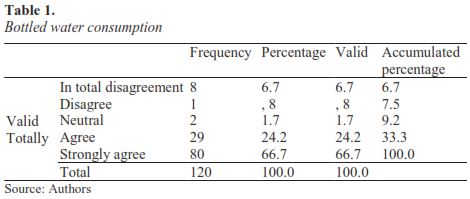
Table 1 shows that 66.7% of the 120 people asked, totally agree while 24.2% agree to consume purified water from the four companies under study. On the contrary, 6.7% strongly disagree to consume this type of product.
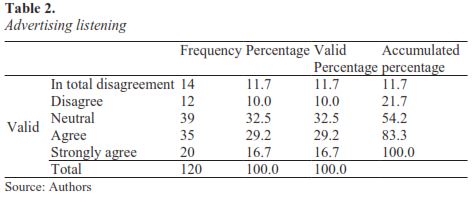
Table 2 shows that 29.2% of respondents agree to have heard advertisements from one of the purified water brands in Bahía de Caráquez, 16% totally agree to have heard advertising information from The brands under study, on the other hand, 21.7% said they disagreed and disagreed that they had heard some advertising piece.
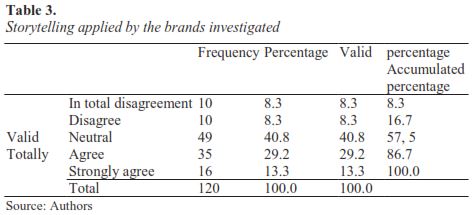
Table 3 shows that 29.3% and 13.3% of those consulted fully agree and agree, respectively, regarding the contents / history) of the advertising pieces of water companies bottled up. While 16.6% disagree and disagree, respectively, of the stories used by the ambassadors to communicate with their target audience.
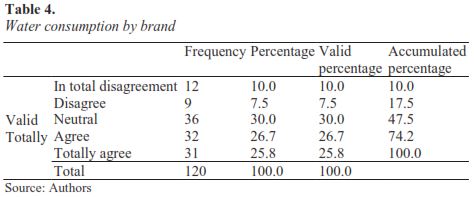
Table 4 shows that 26.7% and 25.8% of respondents mentioned agreeing and in total agreement, respectively, to consume bottled water according to the brand. While 10% indicated that they disagree in Consume water consumed by the brand.
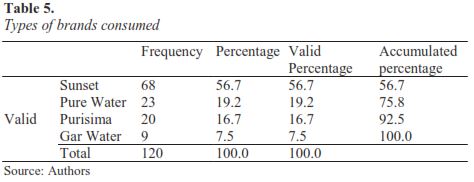
Table 5 shows that 56.7% of the purified waters that they are consumed in the city of Bahía de Caráquez, among the 120 people surveyed, corresponds to the company Sunset, followed by the Pure water brand that has 19.2%, Purísima with 16.7% and finally Gar Water with 7, 5% of the citizen preference.
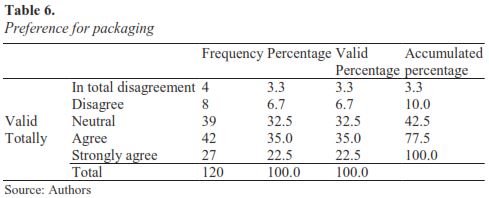
Table 6 shows that 35% and 22.5% respectively agree and totally agree with the types of pregnancies in which purified waters are marketed while only 10% of those consulted mentioned disagreeing and in total disagreement regarding the pregnancies in which they receive this type of product.
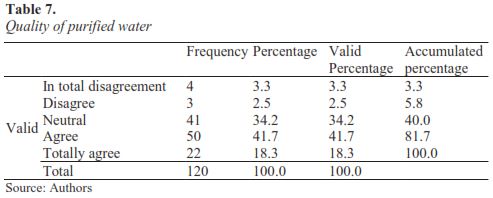
Table 7 shows that 41.7% and 18, 3%, respectively, agree and totally agree with the quality of the pregnant water while only 5.8% of the respondents expressed disagreement and total disagreement regarding the quality of water they receive.
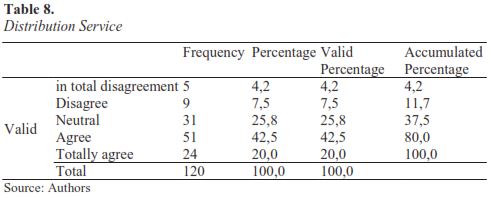
Table 8 shows that 42.5% and 20%, respectively, agree and totally agree on the bottled water distribution service while only 11.7% of respondents said they disagree and strongly disagree about the distribution service they receive from the target Companies study.
DISCUSSION
The study has raised the benefits of stimulating the senses of purified water consumers through the creation of stories that generate confidence and security in the purchase and consumption of bottled waters, as well as causing the positioning of each of the companies investigated: Sunset, Pure water, Purísima and Gar Water.
According to the results of the survey applied, in a random sampling, to the consumers of the three companies, a high percentage indicates that Sunset tops the list of the most consumed brands locally, result that could be assumed because said company has its plant in the town of Bahía de Caráquez while the other two in more distant cities such as Portoviejo and Manta.
The respondents mentioned that they have little knowledge of the brands due to the lack of advertising pieces in off and online media. Although each company maintains a Facebook page. A high percentage of those asked think that the contents or stories that advertise the brands are not relevant. They also consider important attributes such as water quality and the types of containers in which they are sold.
The ambassador Sunset, who leads the preferences in a high percentage in the market of purified waters within the city of Bahía de Caráquez, presents a radio advertising, the same that could not be considered as emotional in itself, except for the fact that the speech is made by an announcer who ceased to exist, but was estimated by the community, which could be thought that this circumstance motivates consumers. However, this brand could expand its service field and increase its range of consumers if they plan to carry out an emotional marketing campaign based on a good story.
The quality of the water and the packaging are another of the elements by which consumers make a decision to purchase these products for daily consumption, so continue maintaining the quality of the product and a good design, supported by emotional stories that approach the Consumer sensitivity will enable the expansion of the consumer market and the expansion of its target groups.
The limitations that have been presented in the research is the non-existence of previous studies of this theme and in this commercial area, hence the importance and contribution of the present study in improving the visibility, attraction and advertising positioning of the ambassadors.
However, to the aforementioned, the aforementioned producers of purified water that compete in a market of about 30 thousand inhabitants, do not warn that carrying out an emotional marketing plan based on stories that move consumers could double or triple their sales in a market where the purchase of this type of water every day is increasing.
CONCLUSIONS
BIBLIOGRAPHIC REFERENCES
Ashforth, B. E., & Humphrey, R. H. (1995). Emotion in the Workplace: A Reappraisal. Human Relations, 48(2), 97–125. https://doi.org/10.1177/001872679504800201
Bigné, & Andreu. (2004). Modelo cognitivo-afectivo de la satisfacción en servicios de ocio y turismo. 89–120.
Cadavid. (2004). Marketing de emociones: la forma para lograr fidelidad de los clientes. Semestre Económico, 7(13), 203–211.
Carpio, Serezade, Cutipa, & Flores. (2019). Estrategias del marketing viral y el posicionamiento de marca en los restaurantes turísticos de la Región de Puno Strategies of the viral marketing and the positioning of brand in the tourist restaurants of the Puno Region. 10(1), 70–80. Retrieved from http://www.scielo.org.pe/pdf/comunica/v10n1/a06v10n1.pdf
Cepeda-Palacio, S. D. (2014). AlcAnces ActuAles del concepto de mArcA. un estudio compArAtivo, en lA historiA. 10(2), 128–142.
de Aguilera-Moyano, J., Baños-González, M., & Ramírez-Perdiguero, J. (2015). Branded entertainment: Los contenidos de entretenimiento como herramienta de comunicación de marketing. Un estudio de su situación actual en España. Revista Latina de Comunicacion Social, 70, 519–538. https://doi.org/10.4185/RLCS-2015-1057
Dioses, K. R., Rojas, T. A., & Moreno, H. P. (2017). De la comunicación multimedia a la comunicación transmedia: Una revisión teórica sobre las actuales narrativas periodísticas. Estudios Sobre El Mensaje Periodistico, 23(1), 223–240. https://doi.org/10.5209/ESMP.55593
Foromarketing.com. (2019). Marketing experiencial: ¿cómo enamorar a tu cliente? Retrieved from https://www.foromarketing.com/marketing-experiencial-enamorar-cliente/
Godin, S. (2006). ¿Todos los comerciales son mentirosos? Los actuales vendedores de sueños. 12.
Guisado, A. (2017). "STORYTELLING": Cómo contar historias ayuda a la estrategia de marketing. 56. Retrieved from https://idus.us.es/xmlui/bitstream/handle/11441/75910/Storytelling_como_contar_historias_ayuda_a_la_estrategia_de_marketing.pdf?sequence=1
Hochschild, A. R. (2012). The Managed Heart Commercialization of Human Feeling. https://doi.org/10.1017/CBO9781107415324.004
Jiménez, & Calderon. (2004). Dirección de Productos y Marcas. Retrieved from https://books.google.com.ec/books?id=HoEuFuv_xmcC&pg=PA12&lpg=PA12&dq=Dirección+de+productos+y+marcas&source=bl&ots=mfOxm5pe4g&sig=ACfU3U0pTV89zXupUCayudhyk5HrG1scKg&hl=es&sa=X&ved=2ahUKEwiGmNPBsvXlAhUO01kKHdQwB48Q6AEwCHoECA4QAQ#v=onepage&q=Direccióndep
Kotler, & Keller. (2006). Dirección de Marketing.
Loizate Fondevila, M. (2015). Storytelling transmedia. Factores que influyen en la participación activa del usuario en campañas publicitarias basadas en estrategias de storytelling transmedia. RECERCAT (Dipòsit de La Recerca de Catalunya). Retrieved from http://recercat.cat/handle/2072/257212
Muller, K. (2016). El papel de las marcas en la nueva era de la comunicación publicitaria. Opcion, 32(Special Issue 12), 39–65. Retrieved from https://produccioncientificaluz.org/index.php/opcion/article/view/22035/21759
Muñoz. (2004). La satisfacción del consumidor en las experiencias hedonistas. 52–67.
Nuñez, V. (2018). Qué es el Storytelling y cuáles son sus características esenciales. Retrieved from https://vilmanunez.com/que-es-storytelling/
Salmon, C. (2008). Storytelling. La máquina de fabricar historias y formatear las mentes. El Cultural. Retrieved from https://elcultural.com/Storytelling-La-maquina-de-fabricar-historias-y-formatear-las-mentes
Scolari, C. (2008). Hipermediaciones. Retrieved from https://hipermediaciones.com/2008/11/02/definiendo-las-hipermediaciones/
Velilla, J. (2012). La experiencia cliente desde la perspectiva de la marca. Retrieved from https://www.managementsociety.net/2013/02/19/la-experiencia-cliente-desde-la-perspectiva-de-la-marca/
Vizcaíno, P. (2016). Del storytelling al storytelling publicitario: el papel de las marcas como contadoras de historias. 410. Retrieved from http://e-archivo.uc3m.es/handle/10016/24104#preview
Recibido el: 11/12/2018
Aceptado el: 15/11/2019